Don Bowman
Hillbilly ElegyDon Bowman is J.D. Vance’s biological father, separated from him by adoption and reunited with him during a period of upheaval in J.D.’s childhood. Their renewed relationship gives J.D. access to a family history and a version of the adoption that he had not previously heard. Don’s home also offers a striking alternative to the volatility J.D. had experienced: a steady routine, shared meals, and adults who did not turn disagreement into shouting. Yet the account does not make Don’s past uncomplicated; family members describe his early marriage to Mom differently, and Don denies having physically abused anyone.
Identity and Family Background
Don’s connection to J.D. reaches beyond biology through a shared sense of belonging in Kentucky. Don’s father, Don C. Bowman, had migrated from eastern Kentucky to southwest Ohio for work. After Don C. Bowman died suddenly, leaving two young children and a young wife, Don’s mother remarried, and Don spent much of his childhood in eastern Kentucky with his grandparents. The family history thus joined migration for work with an early loss and a childhood divided between households.
J.D. understood Don’s attachment to Kentucky because he recognized the same feeling in himself. Don had grown up among his own people, with space to be himself; his mother’s second husband was a good man, but he was firm and an outsider. J.D. likewise felt more at ease in Kentucky, where he did not experience the same pressure to impress people or fear of embarrassing himself. That shared recognition gave their relationship a point of connection beyond the years they had missed.
Return to J.D.’s Life
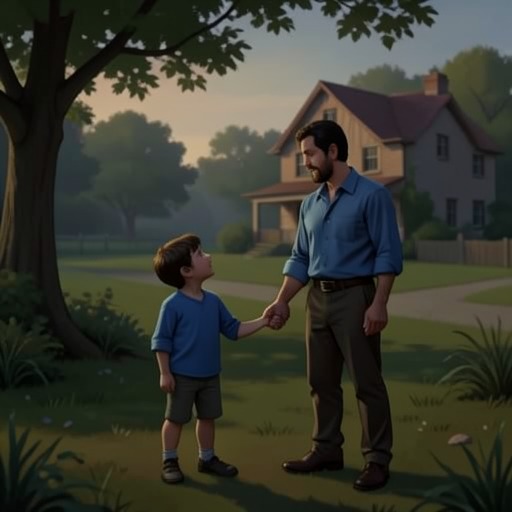
When Bob seemed to be regretting the responsibility of raising another child, Mom called J.D. into the living room to speak with Don by phone. Don asked whether J.D. remembered wanting a farm with horses, cows, and chickens, and whether he remembered his siblings, Cory and Chelsea. J.D. remembered the farm idea and only a little about the children. Don then asked whether he wanted to see him again. J.D. knew little about his biological father and barely recalled life before Bob adopted him, so the call opened a relationship that had nearly disappeared from his conscious memory.
J.D. had been told that Don abandoned him to avoid child support. He also knew that Don was married to Cheryl, was tall, and was thought to resemble him. Mamaw had described Don as a charismatic Christian, a characterization that made J.D. curious about church as well as about his father. J.D. asked Mom whether he could see Don, and she agreed. The timing made the reunion especially consequential: as his legal father left his life, his biological father returned. After trying a succession of men as possible father figures for her children, Mom had come back to the original candidate.
A Different Household
Don’s fourteen-acre property gave the relationship a concrete setting. It had a modest house, a pond stocked with fish, fields for cows and horses, a barn, and a chicken coop. The children gathered seven or eight eggs most mornings, ran around the property with a dog, caught frogs, and chased rabbits. Don had grown up with similar rural routines, and the landscape also echoed J.D.’s time with Mamaw in Kentucky. The farm was not simply a pleasant visit; it embodied the kind of childhood landscape father and son both recognized.
J.D. also found ordinary domestic rhythms in Don’s household that he had long wanted. Cheryl was usually home, Don returned from work at about the same time each day, and dinner was made and eaten together. They said grace before meals, watched family sitcoms on weeknights, and did not scream at one another. J.D. once heard them raise their voices over money, but the disagreement did not become the kind of shouting he had known elsewhere. On his first weekend when he understood he would not be sent away again on Monday, he fished in the pond, fed the horses, ate grilled steak, and watched Indiana Jones films late into the night with his younger brother and the brother’s friend. The evening’s ordinariness was precisely what appealed to him.
The Adoption and Conflicting Memories
As J.D. spent more time with Don, the pain and unanswered questions surrounding the adoption remained present. Don said that he had not given J.D. away to avoid child support. Instead, he said he had hired multiple lawyers and done what he reasonably could to keep his son. He had reconsidered his approach to the custody dispute after seeing how frightened J.D. was during visits: before the adoption, J.D. would hide under a bed for the first few hours, afraid that Don would take him away and prevent him from seeing Mamaw.
Don also said that Mamaw’s hatred of him arose from the early years of his marriage to Mom, when he had not been a perfect husband. J.D. knew that Mamaw had opposed him; he remembered her standing on the porch when Don came to collect him, watching him while keeping a weapon concealed. Don’s account did not erase the fear or the family’s hostility, but it complicated the earlier claim that he had simply abandoned his son. When Don spoke with the court’s child psychiatrist, he learned that J.D. was acting out at school and showing emotional difficulties. J.D.’s kindergarten struggles, including being held back after a few weeks, gave the custody conflict consequences that extended beyond the adults’ competing accounts.
Faith, Change, and Later Tensions
Accounts of Don’s character during his marriage to Mom were conflicting but broadly negative. Mamaw, Aunt Wee, Lindsay, and Mom described him as mean, prone to yelling, and at times physically aggressive toward Mom. Lindsay connected a childhood memory of Don pushing Mom to J.D.’s unusually large, misshapen head. Don denied ever physically abusing anyone, including Mom. J.D. suspected that the couple had pushed one another and thrown plates, but he distinguished this from more severe violence. He understood Don to have changed for the better between the end of that marriage and his marriage to Cheryl, which began when J.D. was four; Don credited a deeper involvement in his faith with that change.
Don’s church also made faith tangible to J.D. It could offer people struggling with addiction a community of support, provide expectant mothers with housing and practical classes, and connect people who needed work with jobs or introductions. When Don faced financial trouble, members of the church joined together to buy his family a used car. J.D. was drawn to this kind of practical help even while knowing that religion had played a significant role in the adoption that separated them. In Don’s life, faith therefore stood both as a source of family rupture and as a network of support.
Their relationship did not remove the differences between their expectations. When Don learned that J.D. had decided to attend Yale Law School, he asked whether J.D. had misrepresented himself on his applications by pretending to be Black or liberal. The question reflected Don’s mistrust of one prominent route to advancement, even though he had never disparaged hard work. J.D. treated the exchange as evidence of how limited working-class expectations could become, rather than as proof that Don opposed effort itself. Later, Don was among the family members J.D. thanked for sharing memories and remaining part of his life. The relationship thus endures as both an intimate reconciliation and a continuing encounter between different understandings of opportunity, family history, and belonging.